Our Speakers

Lee Morton
Head of Cyber Security
CBG

Robin Smith
CISO
Great British Energy - Nuclear

Rob Black
Group Digital & Technology Director
Bruntwood

Professor Gerard Milburn
Quantum Fellow
UK National Quantum Computing Centre

Jon Mattey
CISO
Forge Holiday Group
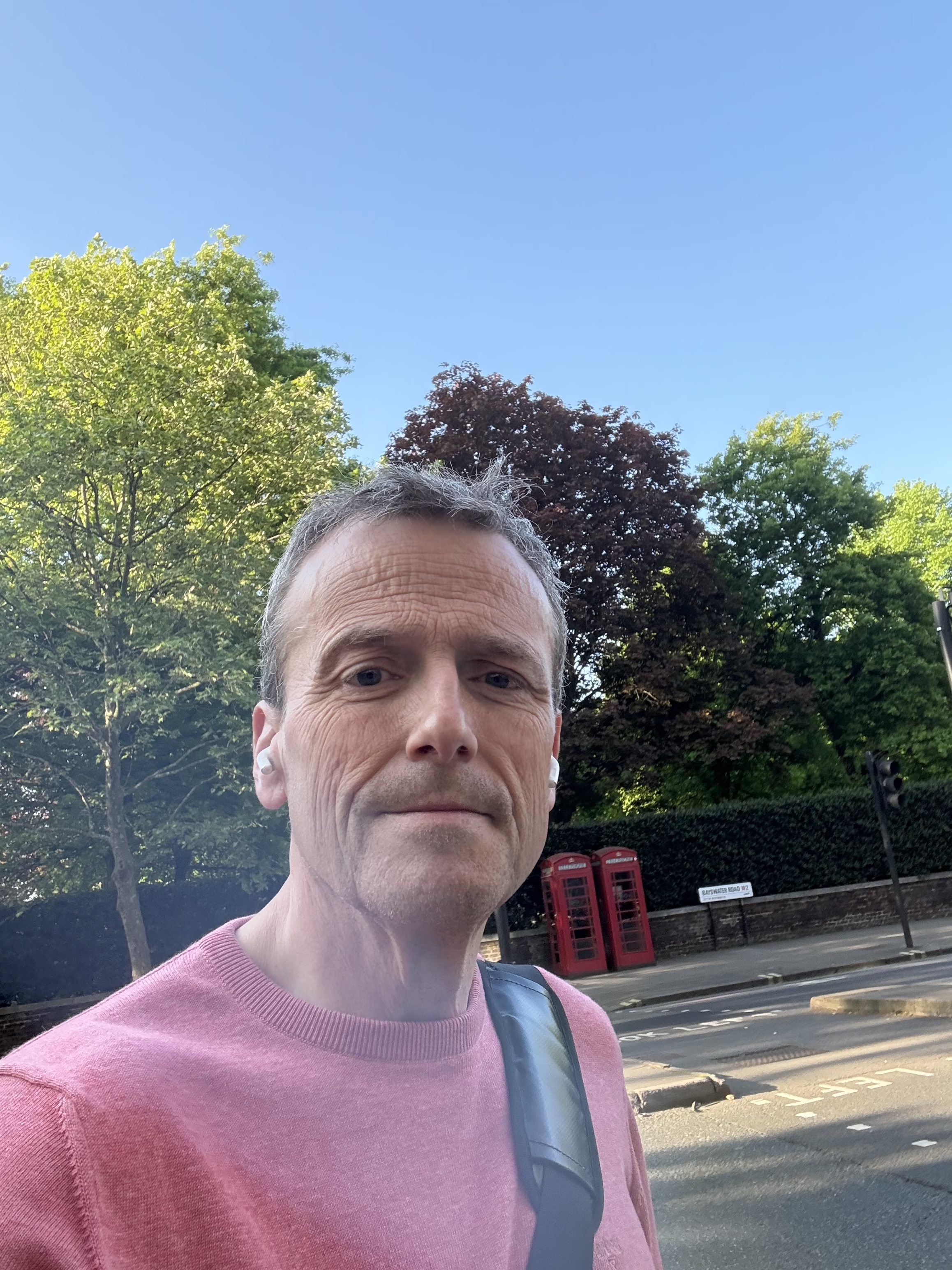
Michael Heritage
VP Cyber Security
Financial Times

Jay Vinda
Global CISO & Cyber Risk Engineering Lead
Mosaic Insirrance

Petra Vukmirovic
Head of Information Security & IT
Numan
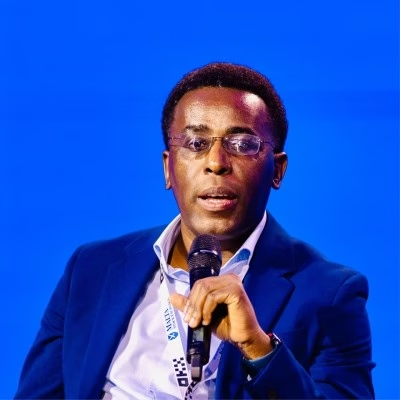
Siegfried Moyo, Director
Director, Cyber| IT| AI Security
Americold Logistics

Gabriela Ahmadi-Assalemi
CISO
University of Cambridge

Dhruv Bisani
Cyber Resilience Director
Starling Bank

David Edwards
VP Information Security
Payroc
IDC forecasts that by 2026, 40% of UK firms will face regulatory penalties tied to resilience failures, while Deloitte notes that incident response maturity is now a differentiator in cyber insurance premiums.
The reality is stark: ransomware, destructive malware, and state-sponsored campaigns are no longer rare events but recurring crises. Boards and regulators expect CISOs to demonstrate not just prevention, but recovery and continuity.
This session explores how leaders design board-level playbooks, integrate legal and PR teams into crisis response, and measure resilience with metrics that matter to regulators and insurers. The conversation will highlight why resilience is now a competitive differentiator, not just a compliance checkbox.
CISO
Great British Energy Nuclear
Global CISO & Cyber Risk Engineering Lead
Mosaic Insurance
VP Cyber Security
Financial Times
Scaling AI agents beyond simple pilots requires more than just high-performing models; it requires an independent control layer. This introduces AI Commander as a complete solution framework, focusing on how a unified platform can detect hidden risks, enforce consistent policies, and provide AI resilience through precision rollbacks.
Attendees will learn how to transition from siloed, ad-hoc security to a proactive "inside-out" architecture built on deep contextual data insights.

EMEA Field CTO
Securiti AI

Endpoint management often evolves into a patchwork of disconnected tools and reactive processes. In this case study, we’ll explore how one of NinjaOne's partners consolidated its endpoint stack, modernized patching, and aligned vulnerability prioritization with business risk.

Senior Channel Account Manager
NinjaOne

Global volatility is no longer background noise — it is the defining context for cybersecurity strategy. IDC projects worldwide security spending will surge by 12.2% in 2025, reaching $377 billion by 2028, as organisations confront politically charged threat environments and escalating state actor campaigns. Gartner’s 2025 trends highlight that boards now view cyber risk as a direct threat to shareholder value, yet many security functions remain reactive, failing to adapt when business priorities shift. The imperative is clear: resilience must be embedded into the DNA of security programs, enabling continuity, agility, and strategic foresight. This panel will examine how CISOs can move beyond “defense-first” thinking to position cyber resilience as a driver of trust, competitiveness, and long-term business outcomes in a fractured global landscape.
CISO
Forge Holiday Group
Head of Cyber Security
GBG

Security Controls Partner
NatWest
Organisations believe they understand their application landscape. The reality is different. Unknown apps, orphaned accounts, and unmanaged behaviours create identity dark matter — hidden risk living outside traditional identity tools.
At the current pace of discovery and onboarding, it can take years to bring these applications into existing identity controls and Agentic AI raises the stakes even further.
This session explores why identity has become fundamentally broken, how identity dark matter emerges, and how Orchid is helping some of the world's largest enterprises fix the problem.

Job Title
Orchid Security

Roundtable Discussion 1: Third Party Risk in the Age of AI Vendors
AI vendors are rapidly entering supply chains, often with opaque models and data practices. This roundtable examines how to assess and manage third party risk when AI is part of the equation.
Moderation Questions:
- What’s different about assessing AI vendors compared to traditional suppliers?
- How do you verify claims about data handling and model security?
- Should regulators mandate AI vendor transparency, or should industry self regulate?
- What’s one control you’d never compromise on with an AI supplier?
Roundtable Discussion 2: AI or Die: Achieving the Autonomous SOC
In the era of AI-accelerated adversaries, organizations must transform their SOC and empower defenders to overcome alert fatigue and burnout. Join this session to explore how leading security teams are implementing autonomous SOC capabilities to reduce manual workloads, accelerate detection and response, and enable analysts to focus on strategic threats.
Host: Robbie Jakon-Whitworth, Senior Solutions Engineer EMEA, Torq

Roundtable Discussion 3: Cybersecurity Benchmarking
Benchmarking maturity is essential, but many metrics are vanity. This session explores how to measure what matters.
Moderation Questions:
- What’s the most meaningful benchmark you use internally?
- How do you compare maturity across industries?
- Should benchmarking be standardized or remain sector specific?
In the past, compliance efforts have largely centred around providing a snapshot of security at a specific moment. However, with evolving regulations like DORA, NIS2, and others, this approach is becoming outdated. These new standards demand a more dynamic and continuous view of security.
This session will unpack the operational, cultural, and technological changes required to move from static reporting to living, breathing security assurance, and why this shift is essential for organisations facing increasing regulatory scrutiny, expanding attack surfaces, and rising expectations from boards and customers.
Head of Cyber Security
GBG
80% of enterprises are deploying AI, but only 20% have robust AI security frameworks (451 Research). McKinsey warns that adversarial AI attacks could cost industries $300B annually by 2030.
As UK firms embrace generative AI for SOC automation, fraud detection, and customer engagement, attackers are exploiting model manipulation, data poisoning, and prompt injection. The challenge is balancing innovation with risk: how to harness AI’s productivity gains without exposing organisations to novel attack surfaces.
This session explores governance frameworks, case studies, and the role of CISOs in shaping AI adoption strategies that are secure, ethical, and resilient.
Group Digital & Technology Director
Bruntwood
Director, Cyber | IT | AI Security
Americold Logistics
Security Controls Partner
NatWest

Data Protection Officer
NIC
With new regulations on AI, data privacy, and cyber resilience, compliance is no longer optional. This keynote shows how CISOs can move beyond checkbox compliance to leverage regulatory readiness as a differentiator in customer trust and market positioning.
Job Title
Rubrik

This session will review a case study of a major US bank facing security challenges that blocked their planned deployment of enterprise AI agents across over 100 petabytes of structured and unstructured data.
The bank struggled with a lack of data trust for AI consumption, the massive scale of metadata management, and complex regulatory compliance. Learn how the bank transformed data security and compliance to enable safe agents by moving at business speed and automating risk detection.
We will discuss the journey to establish strong AI governance, enabling the safe and accelerated adoption of enterprise knowledge agents, and the key finding that data must be classified and labeled before utilization by any AI agent.
EMEA Field CTO
Securiti AI
Boards increasingly demand quantifiable proof of cybersecurity investment value. This keynote examines frameworks for measuring ROI in terms of risk reduction, resilience, and regulatory alignment, equipping CISOs to communicate security’s business impact with clarity.
Job Title
ThreatLocker

Security operations centers are overwhelmed by alert fatigue and talent shortages. This session explores how AI-driven analytics, automation, and orchestration can transform SOC efficiency, reduce false positives, and enable faster incident response.
Job Title
Veracode
Forrester reports that 60% of breaches in 2025 originated in third-party ecosystems, underscoring the fragility of extended supply chains. PwC highlights that supply chain risk is now a board-level KPI, with regulators demanding evidence of vendor assurance.
In sectors like healthcare and finance, attackers exploit weak links in outsourced IT, cloud providers, and logistics partners to gain entry. The challenge is compounded by geopolitical instability, where state actors target suppliers to disrupt critical national infrastructure.
This panel examines frameworks for continuous vendor assurance, contractual clauses, and intelligence-sharing networks that allow CISOs to “trust but verify” in an era where supply chain compromise is the fastest-growing attack vector.
Cyber Resilience Director
Starling Bank
CISO
University of Cambridge
VP Information Security
Payroc
Quantum computing is accelerating fast, but what does that really mean for enterprise security? In this fireside interview, Professor Gerard Milburn, Quantum Fellow at the UK’s National Quantum Computing Centre, cuts through the hype to give CISOs a clear, practical view of the risks, timelines, and strategic decisions that matter now.
From the future of cryptography to the rise of “harvest now, decrypt later” threats, this session offers a rare opportunity to hear directly from one of the UK’s leading quantum thinkers on how to build long-term resilience in a rapidly shifting landscape.
Quantum Fellow
UK National Quantum Computing Centre
Cybersecurity leaders operate under relentless pressure: 24/7 threat landscapes, talent shortages, and escalating board expectations.
This session explores how mental health, burnout, and diversity intersect, and how CISOs can build cultures that are resilient, inclusive, and psychologically safe.
Panelists will share lived experiences, practical strategies, and leadership lessons for sustaining high performance without sacrificing wellbeing.

CISO
Astley Digital
Past & Current Sponsors